




Criminal Law

Magistrate Must Give Reasons When Ordering FIR Despite Police Report Of 'No Offence': Supreme Court
The Supreme Court has recently held that a Magistrate who rejects a police report stating that no cognizable offence is made out must record reasons for doing so before directing registration of an FIR under Section 156(3) of the Code of Criminal Procedure, 1973 (CrPC, now Section 175(3) of the Bharatiya Nagarik Suraksha Sanhita, 2023/BNSS).A bench of Justice Vikram Nath and Justice Sandeep Mehta ruled so while quashing an FIR registered by the Economic Offences Wing (EOW), Delhi, against...

'Delay In Trial Cannot By Itself Override Stringent Bail Conditions Under PMLA': Jharkhand High Court Refuses Bail In 750-Cr Fraud Case
The Jharkhand HC has held that prolonged incarceration or delay in trial cannot, by itself, override the stringent bail conditions prescribed under Section 45 of the Prevention of Money Laundering Act, 2002 (PMLA). The Court observed that while the period of custody is a relevant consideration, the seriousness of the alleged offence, its societal impact and the statutory restrictions governing bail must also be taken into account.A Single Judge Bench of Justice Sujit Narayan Prasad rejected the...
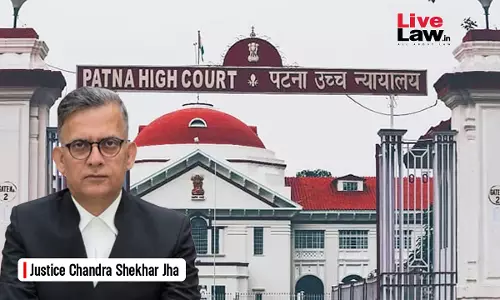
'Public Servant Who Retired Before Cognizance Cannot Claim Protection Under PC Act For Offence Committed During Tenure': Patna High Court
The Patna HC has held that a public servant who retired before cognizance was taken against him cannot claim protection under Section 19 of the Prevention of Corruption Act, 1988, merely because the alleged offences were committed during his official tenure. The Court further observed that protection under Section 197 CrPC cannot automatically be invoked simply because the alleged acts were performed while holding public office.A Single Judge Bench of Justice Chandra Shekhar Jha dismissed a...

'Mere Position As School Principal Does Not Attract Liability U/S 19 POCSO Act Without Knowledge Of Offence': Patna High Court
The Patna HC has held that merely holding the position of Principal of a school does not automatically attract criminal liability under Sections 19 and 21 of the Protection of Children from Sexual Offences Act, 2012 (POCSO Act), unless there is material establishing knowledge or apprehension of the commission of a sexual offence and a consequent failure to discharge the statutory duty to report it.A Single Judge Bench of Justice Sunil Dutta Mishra quashed criminal proceedings against a school...

Why Are Gangsters Act FIRs Still Being Lodged Despite SC Declaring Law 'Stillborn'? Allahabad High Court Questions UP Authorities
Allahabad HC slams authorities' inaction in adhering to Supreme Court ruling declaring Gangsters Act 'stillborn'.

Rajasthan High Court Defers Interim Relief On IAS Officer Shikhar Agrawal's Plea In Corruption Case Over Luxury Villas
The Rajasthan High Court has deferred consideration of interim relief sought by IAS officer Shikhar Agrawal in a corruption case concerning the purchase of luxury villas in Udaipur and Alwar.The bench of Justice Anil Kumar Upman observed that the allegations of procedural irregularities in granting approval to the Anti-Corruption Bureau (ACB) under Section 17A of the Prevention of Corruption...

'Stringent Bail Conditions Under PMLA Cannot Override Constitutional Right To Personal Liberty': Jharkhand High Court
The Jharkhand HC has held that the stringent bail conditions prescribed under Section 45 of the Prevention of Money Laundering Act, 2002 (PMLA), cannot override the constitutional guarantee of personal liberty under Article 21 of the Constitution. The Court observed that prolonged pre-trial incarceration, particularly where the trial is unlikely to conclude within a reasonable period, constitutes a substantial ground for granting bail notwithstanding the restrictions under the PMLA.A Single...

28 Years On, Gujarat High Court Upholds Acquittal In POCSO Case; Cites Faulty TIP
The Gujarat High Court upheld a trial court order acquitting a man in a POCSO case noting that the prosecution failed to establish beyond reasonable doubt the identification of the accused in the Test Identification Parade (TIP) conducted by the Magistrate. [2026 LiveLaw (Guj) 319]The court also observed that the IO did not follow the procedure for TIP properly nor did the Executive...
2019 Amendment Enhancing Minimum Punishment Under POCSO Act Not Retrospective: Tripura High Court
The Tripura High Court has reduced the sentence of a man convicted under the POCSO Act from 20 years to 10 years after finding that the Trial Court had applied the enhanced minimum punishment introduced by the 2019 amendment to an offence committed before the amendment came into force.Section 6 of the POCSO Act prescribes the punishment for aggravated penetrative sexual assault. It was amended...
'Mere Driver Of Vehicle Cannot Be Prosecuted Under Essential Commodities Act': Patna High Court
The Patna HC has held that a person cannot be prosecuted under Section 7 of the Essential Commodities Act merely because he was driving a vehicle allegedly involved in the transportation of diverted Public Distribution System (PDS) foodgrains. The Court observed that where there is no evidence connecting the driver to the ownership, entrustment, sale or misappropriation of PDS stock, his...

'Prior Sanction U/S 197 CrPC Mandatory For Cognizance Against Public Servant': Bombay High Court Quashes Cognizance Against IRS Officer
The Bombay High Court has held that prior sanction under Section 197(1)(a) of the Code of Criminal Procedure (CrPC) is mandatory before a court can take cognizance of an offence against a public servant, where the alleged offence has the requisite connection with the discharge of official duties. The Court accordingly quashed the cognizance order and the money-laundering complaint against...

'Hypothecation Of Goods To Bank Does Not Amount To Entrustment Necessary To Constitute Criminal Breach Of Trust U/S 406 IPC': Jharkhand High Court
The Jharkhand HC has held that goods hypothecated to a bank do not constitute property entrusted by the bank to the borrower, and therefore, their alleged sale by the borrower does not attract the offence of criminal breach of trust under Section 406 IPC. The Court further held that to constitute cheating under Section 420 IPC, deception must exist from the inception of the transaction,...