


No Proof Of Harassment Over Demand For 'Radio': Allahabad High Court Acquits Husband In 1982 Abetment To Suicide Case
Sparsh Upadhyay
19 April 2026 3:54 PM IST
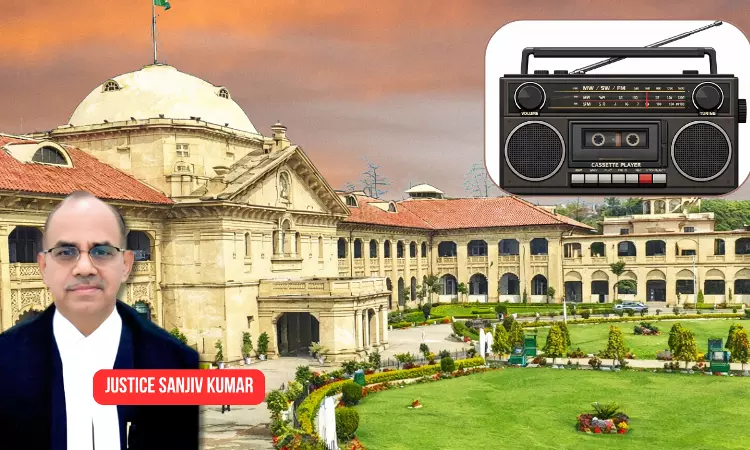
The Allahabad High Court recently acquitted a man in connection with a 1982 abetment to suicide case of his wife. The Court noted that it was not proven that the husband caused any harassment of the victim-wife over the demand for a radio, due to which she allegedly died by suicide.
"...prosecution has miserably failed to prove that the appellant caused any harassment of the deceased and soon before the incident he committed any overt act or omission, which abetted the deceased to commit suicide by setting herself ablaze. There is no such evidence that the appellant committed any harassment to the deceased for want of dowry," a bench of Justice Sanjiv Kumar observed in its operative part of the 18-page judgment.
Briefly put, the appellant, Rameshwar Prasad Gupta, was convicted under Section 306 IPC [Abetment of suicide] and sentenced to undergo RI for 5 years by the additional Sessions Judge, Ballia, in 1985. The in-laws, however, were acquitted.
The Court had concluded that the prosecution had been able to prove that the appellant-husband had harassed the deceased over the dowry demand of a 'two-in-one radio' or Rs. 2000/-. Importantly, the trial court had relied upon the alleged letter of the deceased, written to her mother, demanding either a Radio or Rs. 2000/-.
Challenging the trial court's judgment, the appellant moved the HC.
The Accused-appellant argued that there was not sufficient evidence to prove the charge against him and that the victim/deceased was not subjected to any cruelty or harassment by the appellant.
It was submitted that the victim had herself demanded a radio or Rs. 2,000/- from her mother (through a letter) for her personal use, as she used to remain alone during the daytime. It was argued that the letter in question did not disclose that she was being subjected to any harassment or cruelty by the appellant.
It was further contended that the deceased had accidentally caught fire while cooking and her brother-in-law had promptly rushed her to the hospital.
The AGA, on the other hand, submitted that the prosecution's case was proved beyond a reasonable doubt and that the deceased was subjected to cruelty and harassment for want of dowry by the appellant, which compelled her to die by suicide.
Examining the facts of the case, the trial court's judgment, and the arguments of both parties, the bench, at the outset, noted that the victim's father had lodged an FIR with an unexplained delay of around 25 days, which raised serious suspicion over the prosecution's case.
"If he came to know that the appellant and his family had killed his daughter, then there was no reason for him to inquire from others about her death and also stay with the accused the entire night and lodge FIR after so much delay", the bench noted.
The Court also found force in the accused's arguments that FIR was a fabricated afterthought because the appellant had refused a proposal to marry the victim's sister after the tragedy.
Examining the letter in question, the bench noted that the deceased had simply written to her mother to send a two-in-one radio or Rs. 2000/- and nowhere did it mention that the victim was being asked to fulfil the said demand by the appellant.
Furthermore, the Court examined Section 306 IPC to note that mere harassment is not sufficient to constitute an offence under this section.
"[the harassment has to be] accompanied by deliberate acts of incitement or facilitation and the act or omission of the accused should be proximate to the time of suicide, and should have clear connection between the accused's behaviour and the tragic outcome", the Court remarked.
The Court added that from the evidence of PW 1 and PW 2, it was not clear as to what kind of harassment was caused to the deceased by the appellant.
The Court also observed that the appellant's brother taking the victim to the hospital gave force to the contention of the accused that if he had any design to cause her death or to abet her to commit suicide, then she would not have been taken to the hospital.
Consequently, the Court concluded that the prosecution had miserably failed to prove that the appellant caused any harassment of the deceased and that, soon before the incident, he committed any overt act or omission, which abetted her suicide.
With this, the appeal was allowed and the appellant was acquitted of the charge under Section 306 IPC.
Case title - Rameshwar Prasad Gupta vs State of UP 2026 LiveLaw (AB) 231
Case Citation: 2026 LiveLaw (AB) 231