



Delhi High Court Directs Centre To Decide Within 6 Months Plea Seeking Mandatory Body-Worn Cameras For Police During Protest-Control Duties
Nupur Thapliyal
7 Oct 2026 12:48 PM IST
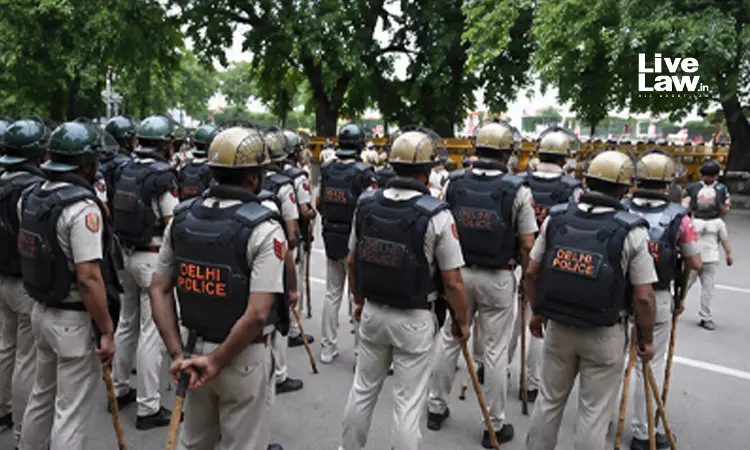
The Delhi High Court on Wednesday directed the Centre to treat a PIL seeking directions for framing Standard Operating Procedure (SOP) making body-worn cameras (BWCs) compulsory and “always-on” for personnel deployed on crowd-control and protest-management duties, as a representation and decide it within 6 months.
The petition, filed by Advocate Chahat Raghav, sought a comprehensive regime governing the storage, integrity, retention and evidentiary use of footage recorded through such cameras.
It was argued that the absence of a mandatory BWC framework impacts the fundamental rights guaranteed under Articles 19(1)(a), 19(1)(b) and 21 of the Constitution of India.
A division bench comprising Acting Chief Justice Nitin Wasudeo Sambre and Justice Arun Bhardwaj directed the Centre to communicate its decision to the petitioner within 6 months.
This, after the Additional Solicitor General of India Chetan Sharma appearing for the Centre said that petition can be treated as a representation and decision shall be communicated within six months from today.


"Use of body worn cameras by police can be inferred from not only tender issued but also use of same by traffic police. The SOP is informed to not be in existence. In such event, there might not be in provision in police manual. However, since statement is made from ASG we deem it appropriate to take same on record. We direct the respondents to communicate decision on framing of SOP regarding use of BWCs within six months. In case petitioner is aggrieved by inaction, liberty is granted to approach court afresh," the court said.
Appearing for the petitioner, senior advocate Akhil Sibal argued that the petitioner was seeking a mandatory procedure for body worn cameras. He said that the cameras are used but it seems to be used in a very sporadic way.
"This is essential because allegations keep surfacing. When protest takes place, there is allegation of excessive force used by police or protestors running and violence at their end. We need a system so that the allegations are not left to private persons who are videographing. All that comes into question," Sibal said.
Sibal also said that there was a standing order of 2022 on the issue.
On the court's query regarding how use of body worn cameras affects right of public at large, Sibal said that when violence occurs there are allegations and counter allegations of violence and the issue pertains to accountability as to who is perpetrating violence and the use of excessive force by police.
He argued that there has to be some way for fixing accountability.
The court orally asked if the petitioner had narrated any incident that these cameras were misused by police.
Sibal responded that some procedure needs to be laid down and this issue was not directed at any particular incident or inquiry. The court however asked as to why it should direct government to legislate, to which Sibal said that a process can be formulated and authorities can be directed to follow it.
On the court's query, Sibal said that there were no provisions regarding body worn cameras under criminal laws (particularly BNSS). However, he added that this issue had cropped up time and again yet there was no SOP for the same.
"If technology is available, it can go a long way in fixing accountability whenever required. It is different from facial recognition where there are concerns of surveillance," he argued.
He said that a body worn camera records the entire incident and all movements of the officer. "It cant be selective. It is preserved, has a chain of custody that can be controlled," he said adding that the cameras are used but not as per an SOP.
Meanwhile ASG Chetan Sharma referred to Supreme Court's judgment in Balwant Singh case as well as rules framed by Delhi High Court mandating a representation to be made to authorities before invoking the PIL jurisdiction.
ASG said that there were guidelines for organizing protests wherein videography aspect was taken care of. He said that the petitioner can make a representation for framing of SOPs for using body worn cameras which can be decided as per law.
The plea was filed against the backdrop of the July protests at Jantar Mantar involving the Cockroach Janata Party (CJP) and climate activist Sonam Wangchuk.
According to the petition, allegations of excessive use of force by Delhi Police and RAF were accompanied by allegations of stone-pelting, vandalism and attacks on police personnel.
Raghav submitted that much of the footage documenting the events came from mobile phones of bystanders rather than an official, authenticated police recording system.
She argued that the said position left accountability for alleged police excesses, as well as evidence against alleged violent protesters, dependent upon “happenstance” citizen videography.
Raghav submitted that footage must be generated and preserved through a defined protocol, including safeguards such as hash values, secure server uploads inaccessible for alteration by the officer wearing the camera, an auditable chain of custody and certification under Section 63 of the Bharatiya Sakshya Adhiniyam, 2023.