



Penalty For Delayed Compensation Under Employees' Compensation Act Cannot Be Imposed Without Finding Of Unjustified Delay: J&K&L High Court
LIVELAW NEWS NETWORK
7 Oct 2026 7:35 PM IST
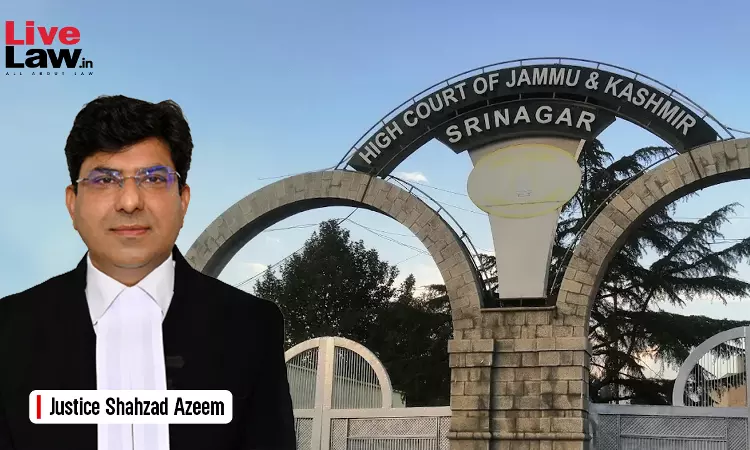
The Jammu & Kashmir and Ladakh High Court has held that while interest on delayed payment of compensation follows the default under Section 4-A(3)(a) of the Employees' Compensation Act, 1923, imposition of penalty under Section 4-A(3)(b) requires a specific finding by the Commissioner that the delay was unjustified and can be made only after giving the employer an opportunity to show cause.
The Court clarified that a mere prayer for penalty by an employee, or the fact that compensation was not deposited within the statutory period, does not by itself justify imposition of the additional penalty of up to 50%.
The Court was hearing an appeal under Section 30 of the Employees' Compensation Act against an award granting ₹93,000 as compensation, along with ₹47,400 as interest, to a causal labourer who suffered 30% permanent disability after a rolling boulder struck his leg while he was working on a road project.
Justice Shahzad Azeem held that “The two clauses are not interchangeable. Penalty is not imposed on a prayer alone.”


Mohi Ud Din was engaged as a casual labourer and was working on September 20, 2006, when a rolling boulder struck his right leg, resulting in permanent disability assessed at 30%.
His monthly wages were ₹3,170. The Assistant Labour Commissioner, acting as Commissioner, awarded him ₹93,000 compensation with interest at 12% per annum from the date of accident till the date of award.
The appellant challenged the award principally on the grounds that his loss of earning capacity ought to have been treated as 100%, that the compensation had been incorrectly calculated and that the Commissioner ought to have imposed a 50% penalty for delayed payment.
Court's Observations:
Adjudicating the matter Justice Azeem first upheld the calculation of compensation. It noted that the appellant's age of 47 years, monthly wages of ₹3,170 and 30% permanent disability were admitted. Applying the relevant factor of 163.07 under Schedule IV, the Court found that the Commissioner had correctly calculated compensation at ₹93,000, the minor difference being attributable only to rounding.
The Court also rejected the claim for compensation of ₹2,58,465, observing that the figure relied upon by the appellant represented the formula applicable to death under Section 4(1)(a), and not permanent partial disablement.
On the claim that the appellant had suffered 100% loss of earning capacity despite 30% medical disability, the Court held that this was essentially a question of fact. Since the injury was non-scheduled, compensation under Section 4(1)(c)(ii) depended upon the loss of earning capacity permanently caused by the injury. The Commissioner had accepted the 30% assessment, and the High Court held that re-appreciation of that factual determination was outside its limited jurisdiction under Section 30.
The Court, however, found substance in the challenge relating to penalty. It explained that Section 4-A(3)(a) makes interest a consequence of default, whereas Section 4-A(3)(b) permits a further sum, not exceeding 50%, only when the Commissioner forms an opinion that there was no justification for the delay.
Referring to the Supreme Court's decision in The Oriental Insurance Co. Ltd. v. Siby George, the Court reiterated that interest follows default, but penalty requires a finding of unjustified delay after compliance with the statutory requirement of giving the employer an opportunity to show cause.
In the present case, the Commissioner had neither issued a show-cause notice under the proviso to Section 4-A(3)(b) nor recorded any finding regarding justification for the delay.
The Court observed that “A prayer in the claim petition, repeated in this appeal, does not supply the proviso, nor the foundational facts on which the opinion has to rest.”
The Court further held that, while exercising jurisdiction under Section 30, it could not itself form the requisite opinion for the first time and impose penalty. That statutory exercise had to be undertaken by the Commissioner.
Accordingly, the Court answered the substantial question of law in favour of the appellant, but confined the relief to the issue of penalty. The matter was remitted to the Commissioner to determine the entitlement to penalty after hearing both sides and following the procedure prescribed under Section 4-A(3)(b).
The Commissioner was directed to dispose of the issue within three months from receipt of the certified copy of the judgment.
The appeal was consequently allowed in part, while the compensation and interest awarded by the Commissioner were upheld.
Case Title: Mohi Ud Din v. Union of India & Others
Citation: 2026 LiveLaw (JKL)
Appearances: For the appellant: O.P. Thakur, Senior Advocate with Anandita Thakur, Advocate. For the respondents: Suneel Malhotra, CGSC.