



- Home
- /
- Supreme court
- /
- Art. 226 | Certiorari Can Be Used...
Art. 226 | Certiorari Can Be Used To Quash Tribunal Decision Which Is Grossly Perverse : Supreme Court
Yash Mittal
31 Aug 2026 7:53 PM IST
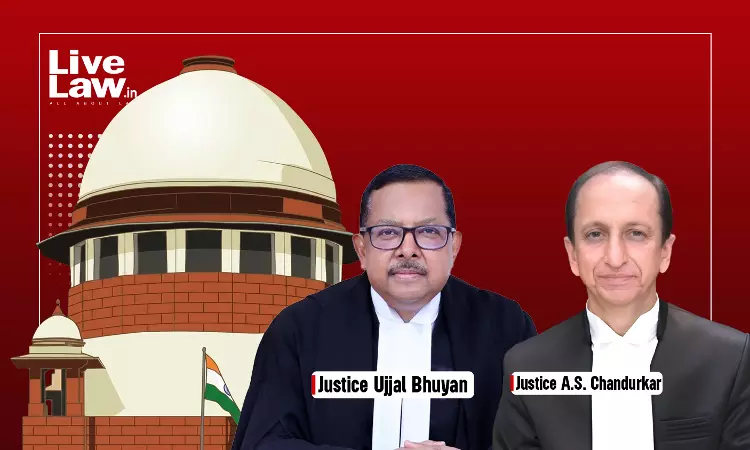
The Supreme Court on Monday (August 31) held that High Courts, while exercising their certiorari writ jurisdiction under Article 226 of the Constitution, can interfere with a Tribunal's order where the findings are unsupported by any material or documentary evidence. “If a finding is recorded without there being any evidence on record or a finding is recorded without any supporting...
This is a premium content
Available exclusively to
Our subscribers
Subscribe Premium 
INR 1099+GST
Your support helps us to bring you more content at
an affordable subscription scheme !!!
All payment options available
The Supreme Court on Monday (August 31) held that High Courts, while exercising their certiorari writ jurisdiction under Article 226 of the Constitution, can interfere with a Tribunal's order where the findings are unsupported by any material or documentary evidence.
“If a finding is recorded without there being any evidence on record or a finding is recorded without any supporting document, whatsoever, a case for interference would be made out since such finding would amount to an error of law.”, observed a bench of Justice Ujjal Bhuyan and Justice Atul S. Chandurkar, while affirming the Delhi High Court's order which had interfered with an order passed by the Tribunal in a societal dispute, as an order passed by an arbitrator was without any supporting evidence.
The dispute arose from the original claimant's claim that he continued to be a member of the Respondent-cooperative housing society and was entitled to allotment of a plot.
The Society's records showed that the claimant had resigned from the Society in 1951, his share was transferred to another member, and his subsequent application for membership was rejected in 1952. Despite this, the Registrar, acting as Arbitrator, later presumed that claimant had continued as a member and awarded the plot to his legal heir.
The Delhi Co-operative Tribunal upheld the award. However, the Delhi High Court set aside both orders, finding that the authorities had ignored crucial documentary evidence.
Aggrieved, the legal representatives of the claimant approached the Supreme Court.
Dismissing the appeal, the judgment authored by Justice Chandurkar said that the High Court rightly interfered with the arbitrator's order as the finding with respect to assumption of the claimant continuing as a member of the Respondent – society was without any supporting documents.
“…the High Court was fully justified in causing interference with these orders by observing that if the relevant documents had been taken into consideration, the same would have resulted in a decision in favour of the Society. We, therefore, hold that no fault can be found with the exercise of certiorari jurisdiction by the High Court.”, the Court said, emphasising that “…though the scope for interference in exercise of certiorari jurisdiction would be limited, an error of law evident from the record is open to correction by the High Court.”
“…a finding of fact based on no evidence or purely on surmises or conjectures could be regarded as an error of law.”, the court said, pointing out that the arbitrator's finding about the claimant's continuing as a member was based on assumption, and hence could not be sustained.
Since the original claimant was never admitted as a member of the Society and, thus, not entitled to seek allotment of a plot, therefore, “the High Court also rightly, in our view, took into account equitable considerations while interfering in exercise of certiorari jurisdiction. In the light of the fact that there were four prior claimants seeking allotment of a plot, the claim of the original claimant was rightly disregarded. This is another reason not to interfere with the High Court's adjudication.”, the Court said.
The appeal was dismissed.
Headnote
Constitution of India, 1950 — Articles 226 & 227 — Scope of Certiorari Jurisdiction — Interference with Concurrent Findings of Fact — Error of Law Apparent on Face of Record — When Justified - A finding of fact recorded by a lower court, arbitrator, or tribunal without any supporting evidence or by ignoring material documentary evidence is perverse and amounts to an error of law apparent on the face of the record, making it amenable to judicial review and vulnerable to correction under a writ of certiorari - Certiorari jurisdiction is supervisory and not appellate in nature; the writ court will not re-appreciate evidence or correct a mere error of fact - if findings of fact are based on “no evidence”, or purely on surmises and conjectures, or where the overwhelming weight of evidence does not support the finding, such perversity constitutes an error of law entitling the High Court to issue a writ of certiorari and set aside concurrent orders. [Paras 12 - 15]
Delhi Co-operative Societies Act, 1972 — Sections 61 & 76 — Claim for Membership and Allotment of Plot — Presumption vs. Cogent Evidence — Equitable Considerations - Where material documentary evidence established that the original claimant had resigned from the membership of the Society in 1951, his shares had been transferred, and his subsequent application for membership in 1952 was specifically rejected, the Arbitrator and the Co-operative Tribunal erred in ignoring such core documents and drawing an unwarranted presumption that the claimant continued to remain a member throughout his lifetime merely because his name appeared on certain lists or in a suspense account - The Delhi High Court, therefore, did not exceed its supervisory writ jurisdiction under Articles 226/227 in quashing the concurrent cryptic awards/orders passed by the Arbitrator and the Tribunal, which were bereft of reasoning and suffered from patent perversity - equitable considerations warranted non-interference with the High Court's decision, as senior/prior eligible claimants could not be bypassed in favour of a person who was not a valid member. [Relied on General Manager, Electrical Rengali Hydro Electric Project, Orissa and others v. Sri Giridhari Sahu and others, (2019) INSC 1020; Hari Vishnu Kamath v. Syed Ahmad Ishaque and others, 1954 INSC 122; Central Council for Research in Ayurvedic Sciences and another v. Bikartan Das and others, 2023 INSC 733; Distinguished from Shalini Shyam Shetty and another v. Rajendra Shankar Patil, 2010 INSC 422; Paras 8 - 17]
Cause Title: SHRI PRAKASH NARAIN SHARMA DEAD THROUGH LEGAL REPRESENTATIVE VERSUS M/S. BURMAH SHELL CO-OPERATIVE RESPONDENTS HOUSING SOCIETY (REGD) THROUGH MANAGING COMMITTEE MEMBER SH. P. JINDAL AND OTHERS
Citation : 2026 LiveLaw (SC) 873
Click here to download judgment
Appearance:
For Petitioner(s): Mr. Jitendra Mohan Sharma, Sr. Adv. Mr. T. V. Ratnam, AOR Mr. Rajendra Prasad Maurya, Adv.
For Respondent(s): Mr. Ashim Vachher, Sr. Adv. Mr. Shantanu Kumar, AOR Mr. Sudhir Kumar Sharma, Adv. Mr. Vinayak Uniyal, Adv. Mr. Prashant Kumar, AOR
Tags

Yash Mittal
Yash Mittal is a Correspondent with LiveLaw, covering the Supreme Court of India

