




Retired Judges Appointed In Central Industrial Tribunals Can't Claim Pay Parity With Other Tribunal Members : Supreme Court
Yash Mittal
13 Aug 2026 3:34 PM IST
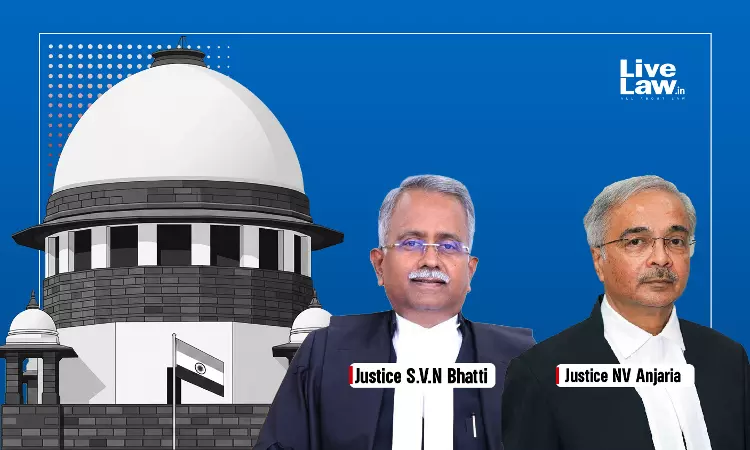
The Supreme Court on Wednesday (August 12) dismissed a writ petition filed by ex-judicial officers, who were re-employed as Presiding Officers of Central Government Industrial Tribunals-cum-Labour Courts, seeking pay scales equivalent to those granted to other National Tribunals under the 6th Pay Commission recommendations.
A bench of Justice SVN Bhatti and Justice NV Anjaria justified the differential pay scales to the petitioners equivalent to that of officers in the District Judiciary as per the Justice E. Padmanabhan Committee, noting that “the re-employed class could be reasonably and rationally classified separately for the purpose of applying pay scales which may not be equivalent to and on the same pedestal with the other classes.”
“Upon re-employment, the reemployed officers/persons would cease to be homogeneous vis-à-vis class of regular officers in employment of the government.”, the Court said.
The petitioners argued that CGIT-cum-LCs stood on the same footing as other Central tribunals, including the Central Administrative Tribunal and Income Tax Appellate Tribunal. They contended that while the government had accepted the 6th Pay Commission recommendations for officers of several such tribunals, CGIT Presiding Officers had instead been placed on pay scales linked to those of District Judges. According to them, this amounted to treating unequal classes alike and violated the constitutional guarantees of equality.


The Union government opposed the claim, pointing out that the petitioners were serving on a re-employment basis after retirement and that their pay fixation was governed by the Central Civil Services (Fixation of Pay of Re-employed Pensioners) Orders, 1986. The government also maintained that the pay structure for CGIT Presiding Officers had been revised on the basis of judicial pay commission recommendations, including those of the Shetty Commission and the Justice E. Padmanabhan Committee.
The Supreme Court reiterated that pay fixation and classification of posts are primarily matters for the executive and expert bodies, and that judicial intervention in such matters is limited. The Bench further held that retired officers who are subsequently re-employed do not remain part of the same homogeneous class as regular government employees.
The Court also rejected the petitioners' challenge to the decision to align the pay of CGIT-cum-LC Presiding Officers with that of the District Judiciary, except for Presiding Officers of the National Tribunals functioning at Mumbai and Kolkata. It found the classification reasonable and noted that the alignment was based on recommendations of expert bodies, including the Shetty Commission and Justice E. Padmanabhan Committee.
“The contention that the presiding officers in CGIT-cum-LCs have been wrongly equated with the officers in the District Judiciary and that the same scales are extended to both has no legs to stand. The industrial tribunals or labour courts in which persons like the petitioners are appointed as presiding officers are established within the State, and equating such presiding officers with the District Judiciary, excepting the presiding officers of National Tribunals functioning at Mumbai and Calcutta, is reasonable and does not book any arbitrariness.”, the Court said.
The petitioners were appointed as Presiding Officers of CGIT-cum-LCs functioning at New Delhi and Hyderabad.
The petitioners contended that CGIT-cum-LCs are tribunals under Article 247 read with Article 323B of the Constitution, and other tribunals like CAT, ITAT, and DRT received 6th Pay Commission scales. However, CGIT-cum-LCs were treated at par with District Judiciary and granted scales recommended by Justice E. Padmanabhan Committee, which they claimed was arbitrary and violative of Articles 14 and 16.
Dismissing the petition, the judgment authored by Justice Anjaria rejected the claim of violation of right to equality principle, noting that “the classification brought out in the instant case for the purpose of applying the pay scales is based on rational and intelligible differentia which distinguishes persons grouped together from those left out of the group.”
The Court said that “classifying the re-employed persons separately for the purpose of applying pay structure and pay fixation clearly satisfies the principles and tests laid down for applying the Equality Clause read with principles underlying Article 16 of the Constitution.”
Further, the Court noted that in matters of dispute over the pay fixation, the remedy of a judicial review is restricted as the “courts are not suited to evaluate and compare on the basis of the affidavits and pleadings, the justifiability or otherwise of the differentiation of the pay scales and that such matters should be best left to the executive.” [See State of U.P. and Others vs. J.P. Chaurasia and Others, (1989) 1 SCC 121]
“…unless mala fides are shown, the Court would respect the fixation of pay scales by the expert bodies or Pay Commissions Committees.”, the Court clarified
Accordingly, the Court held:
“The re-employed officers/persons after the retirement, when re-employed again, stand belong to a separate class. Their claim to avail the 6th Pay Commission pay scales has no basis to assert on the footing of Fundamental Rights or on any other grounds. Grouping them separately with those regularly working and equating them with District Judiciary cannot be said to offend either the tenets of Article 14 or the requisites of Article 16 of the Constitution.”
As a result, the petition was dismissed.
Cause Title: R.K. YADAV & ANR. VERSUS UNION OF INDIA AND OTHERS
Citation : 2026 LiveLaw (SC) 801
Click here to download judgment
Appearance:
For Petitioner(s) Mr. Nishant Krishan Yadav, Adv. Mr. Ranbir Singh Yadav, AOR
For Respondent(s) Ms. Archana Pathak Dave, A.S.G. Ms. Harshita Choubey, Adv. Mr. Kamal Digpaul, Adv. Mr. Bhuvan Kapoor, Adv. Mr. Amrish Kumar (aor), Adv. Ms. Parthvi Ahuja, Adv. Mr. Divyam Aggarwal, Adv. Mr. Raghav Sharma, Adv. Mr. Shreekant Neelappa Terdal, AOR