


Sabarimala Reference | Travancore Devaswom Board Disagrees With Nair Service Society's Argument On Articles 25(2)(b) & 26(b)
Gursimran Kaur Bakshi
15 April 2026 2:14 PM IST
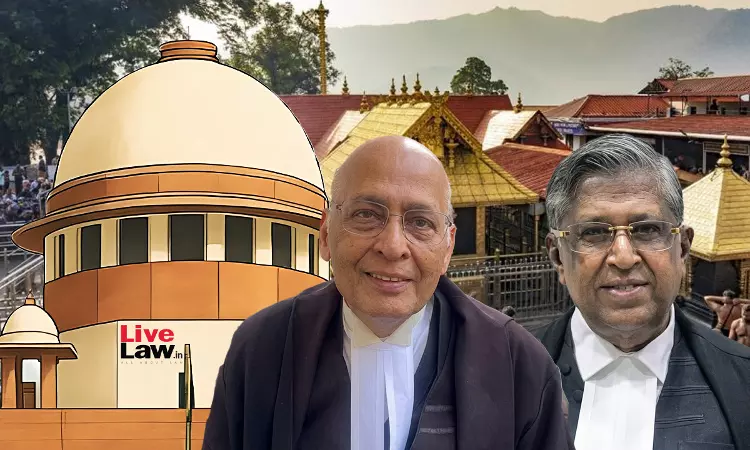
In the Sabarimala Reference hearing before the 9-judge bench of the Supreme Court, the Travancore Devaswom Board disagreed with the argument advanced by the Nair Service Society and certain temple organisations from Kerala that Article 26(b) of the Constitution was subject to 25(2)(b) of the Constitution.
Article 25(2)(b) allows the State to enact law for social welfare and reform or the throwing open of Hindu religious institutions of a public character to all classes and sections of Hindus.
As per Article 26(b), a religious denomination has the fundamental right to manage its own affairs in matters of religion.
Last week, Senior Advocate CS Vaidyanathan, appearing for the NSS, Ayyappa Seva Samajam, Kshetra Samrakhsana Samiti, etc., had argued that Article 26(b) must be interpreted as prevailing over Article 25(2)(b). In other words, the right of a religious denomination to determine who should enter the temple will prevail over the State's power to make law throwing open a Hindu public temple to all sections of Hindus. Vaidyanathan had also argued that the judgment in Sri Venkataramana Devaru v. State of Mysore, which held that Article 26(b) must be read as subject to Article 25(2)(b), was wrongly decided. According to him, Article 25(2)(b) was only an enabling power, which cannot override a specific fundamental right conferred to a religious denomination through Article 26(b).
However, the bench had expressed its reservations with respect to this argument, with Justice Nagarathna saying that excluding other Hindu denominations from a denomination temple would harm Hinduism itself. The bench had also observed that exclusion of denominations might fall foul of 'morality', which is a ground specified in Article 26, to which Article 26(b) right is subject to.
Today, Senior Advocate Dr Abhishek Manu Singhvi, appearing for the Travancore Devaswom Board, adopted a line of argument which was different from that of Vaidyanathan's submissions.
Explaining the interplay between Article 25 and Article 26, Singhvi said :
"Article 25(2)(b) has to be limited to throwing open Hindu religious institutions of public character. The word entry has to be governed by Article 25(2)(b) to the exclusion of Article 26. After you enter for almost everything, Article 26 will take over. I have entered, because the law is there saying you cannot keep me out. However, after I enter, I say, having entered, I have the right to worship in the sanctum in a particular manner. Then Article 26 will take over, and if the collective religious belief of that denomination does not permit anybody except one class to worship in the sanctum, then I can't insist."
In other words, Singhvi argued that while Article 25(2)(b) allows entry of all sections of Hindus to public temples, how the rituals must be conducted within the temple will be governed by Article 26(b). So, if, as per the belief of the denomination, only one section can perform the rituals, then Article 25(2)(b) cannot be invoked by any other class to claim the right to perform rituals, though they have the right of entry. In that scenario, Article 26(b) will apply. He clarified that Article 25(2)(b) will not apply to private temples.
Justice Nagarathna then told Singhvi, "You are saying that 25(2)(b) is sort of an exception to the freedom under Article 26?"
"Exception in the sense, for all issues regualting entry, you have to go to 25(2)(b). Once you enter, Article 26(b) takes over. You cannot regulate entry under Article 26(b)," Singhvi replied. In other words, Article 26(b) cannot be claimed by a denomination to bar the entry of other sects of Hindus to a public temple; however, Article 26(b) will govern the rituals after the entry.
Justice Nagarathna then pointed out that Singhvi's arguments were in contrast to the arguments of Vaidyanathan. "I have written in my submissions that I respectfully disagree with my valued colleague on this point. He suggested you can exclude altogether by the beliefs of that denomination. I don't think that is true of entry. Not only because our founding mothers (of the Constitution) exerted very strongly to insert 25(2)(b), but also because it will make nugatory a large part of our debates which was intended...the whole idea was that, at that time, that kind of practice deserves that kind of approach," Singhvi replied. He thus expressed his disagreement with the argument that Article 26(b) can be used to deny entry to other sections, since Article 25(2)(b) was specifically inserted to address historical practices of discrimination.
At the same time, Singhvi added that Article 25(2)(b) cannot be pressed into service to claim rights over inner rituals. "You would be carrying it too far, if having entered...then I will go to sanctum sanctorum also since I have entered and I have 25(2)(b) right- That 26(b) will stop," he stated.
"One more example we can say, after all persons enter, there can't be discrimination when it comes to serving of food, that only a particular caste people should sit in one room and another case people should sit in another room. That is also forbidden within Article 25(2)(b). There can be reform on that," Justice Nagarathna said. Singhvi said that those situations will be covered by Articles 14 and 15 in any case.
He added that Article 26(b) cannot be invoked to claim that the sections who entered the temple must stand separate and should not come near the deity.
"There could be extreme examples where the denomination says having entered, which we can't stop, our denominational rules require you to stand in a separate part about 1000 yards away and use a telescope to see the deity, and not come anywhere near it,-that will not be justifiable under 26(b). That is an extreme example," Singhvi said.
In the written submissions, the TDB advocated a harmonious interpretation of Articles 25(2)(b) and 26(b).
Regarding the interplay of these two Articles, the TDB said :
"Though laws made under Article 25(2)(b), facially appear to violate Article 26(b), harmonious construction is the only methodology available to give some meaning and scope both to Article (25)(2)(b) and Article 26(b).
Such harmony is arrived at by allowing Article 26(b) untrammelled supremacy regarding all other forms of religion and religious practices but by creating a carve out when a law under Article (25)(2)(b) will prevail if it seeks to mandate access or social reform in certain situations.
Even the latter carve out in favour of the law under Article (25)(2)(b) is subjected to further limitations imposed / imposable by Article 26(b) e.g. prohibitions qua access to the inner most sanctum sanctorum would still be protected under Article 26(b) notwithstanding a law to the contrary under Article (25)(2)(b).
A law as understood under Part III is an essential sine qua non even to begin to intrude upon or regulate upon such issues.
Articles 14 and 15 would be tried to the utmost to be reconciled with Article 25 but in case of impossibility of such harmony, the former would prevail over the over the latter.
The protection of Article 26 is wider and stronger and cannot be tested on the anvil of Articles 14 and 15."
The TDB also stated that "the rights of a religious denomination under Article 26, particularly under Article 26(b) to manage its own matters of religion, can be restricted only on the grounds of public order, morality, and health. These rights cannot be curtailed on the broader grounds of social welfare and reform or by invoking other provisions of Part III."
Also, in case of an conflict between the right to worship of an individual believer under Article 25(1) and the right of a denomination under Article 26, "the right of the denomination would prevail as Article 25(1) is subject to other provisions of Part III which includes Article 26."
The arguments are progressing before a bench comprising CJI Surya Kant, Justice BV Nagarathna, Justice MM Sundresh, Justice Ahsanuddin Amanullah, Justice Aravind Kumar, Justice Augustine George Masih, Justice Prasanna B Varale, Justice R Mahadevan and Justice Joymalya Bagchi.
Today is the fourth day of the hearing.
Live updates can be followed here.