



Shiv Sena Row | ECI's Symbol Allotment May Have To Be Revisited If Speaker's Refusal To Disqualify Is Found Erroneous, Says Supreme Court
Amisha Shrivastava
7 Oct 2026 8:45 AM IST
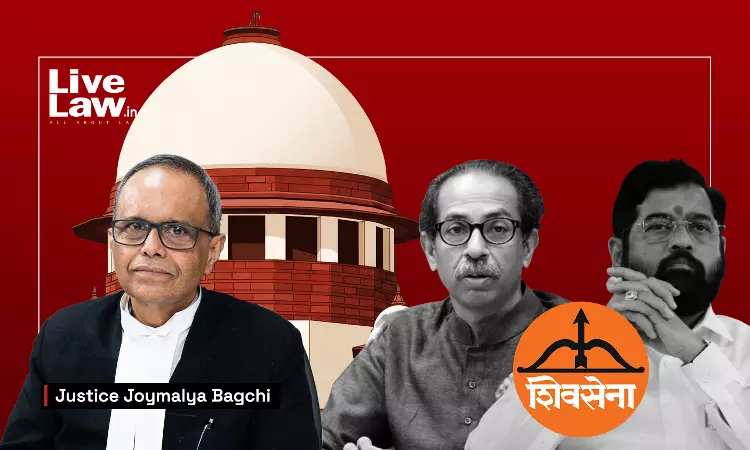
"Will the sentiment of the symbol operate for the persons who have committed the constitutional sin(defection?" Justice Baghchi asked.
In the Shiv Sena case, the Supreme Court yesterday pondered whether the Election Commission's decision recognising the Eknath Shinde faction as the real Shiv Sena and awarding it the party's reserved election symbol would have to be revisited if the Court were to find that the Maharashtra Speaker wrongly rejected disqualification petitions against the faction's MLAs.
“If let us say the disqualification decision is reversed by this court. What will be its impact on the symbol order? If the decision is found to be erroneous, will it not amount to the decision of the Election Commission allotting a symbol to someone who ought to have been disqualified if the law was correctly applied”, Justice Joymalya Bagchi asked.
A bench of CJI Surya Kant, Justice Joymalya Bagchi and Justice V Mohana was hearing the challenge made by Uddhav Thackeray to the Election Commission's decision recognising the Eknath Shinde faction as the real Shiv Sena and allowing it the use of the 'bow and arrow' symbol.
The Speaker, in January 2024, had dismissed disqualification petitions filed by both factions against members of the rival group.


Justice Bagchi raised the hypothetical during submissions by Senior Advocate Neeraj Kishan Kaul, appearing for the Shinde faction.
Kaul was making submissions on the relationship between proceedings before the Election Commission under Paragraph 15 of the Election Symbols Order and disqualification proceedings before the Speaker under the Tenth Schedule.
Kaul relied on the Constitution Bench judgment in Subhash Desai v. Principal Secretary, Governor of Maharashtra to contend that the ECI's determination under Paragraph 15 and the Speaker's determination under the Tenth Schedule operate in different spheres and have prospective effect.
He referred to the judgment which also contemplates a situation where members of the faction awarded the symbol are subsequently disqualified. The judgment observed that the members who remain in the House would then have to follow the procedure under the Symbols Order and other applicable laws for allotment of a symbol.
Justice Bagchi, however, drew attention to another paragraph of the same judgment that states that the consequences of disqualification cannot be brushed aside if a faction enjoying a majority in the House is disqualified after being adjudicated to be the political party, since the foundation of its claim to be the political party would then no longer subsist.
He then asked what would happen if the Supreme Court, while examining the challenge to the Speaker's decision, finds that the Speaker should have disqualified the MLAs. If the ECI had already recognised that faction as the political party and awarded it the reserved symbol, whether the declaration would then have to be revisited, he questioned.
Kaul responded that disqualification operates prospectively and a disqualified MLA remains a member of the political party, although membership of the House is lost. The fact that a person is subsequently disqualified does not annul votes already cast, he submitted.
Justice Bagchi pointed out that enjoyment of a symbol is a continuing right and again questioned whether a later judicial finding could require reconsideration of the ECI's declaration under Symbols Order.
“The enjoyment of a symbol is a continuing right. So once the decision appears to be wrong and it is held to be prospective, will it not be a relevant consideration to revisit the Symbols order in light of the bad declaration?”, he asked.
Kaul submitted that if the Symbols order is revisited, it would result in an endless exercise. He maintained that the Speaker's and ECI's decisions are independent and serve different purposes.
Justice Bagchi pointed out the apparent difficulty arising from different observations in the Subhash Desai judgment. If the Speaker's decision dismissing disqualification is upheld, he noted, there is no further issue. But if the Supreme Court were to find that decision erroneous, he questioned whether the claim that the faction constituted the original political party would require reconsideration.
“If the impact of the declaration is an endorsement of the Speaker's dismissal of disqualification, end of story. But if otherwise, then the claim of being the original political party would require to be revisited. At least if we see Para 154. But I would absolutely agree with you that it has to be seen as a whole because there are again observations which may not be completely in sync because what happens is even if he is disqualified, he remains the political party. And what it says is the disqualified members go away. Remainder members get a different symbol. Now you are just about to read Sadiq Ali. The sentiment of the symbol will operate for the persons who have committed the constitutional sin or will operate for the persons who complained of the constitutional sin? This will be required to be considered by the Election Commission afresh”, he said.
The issue was highlighted by Justice Bagchi during Kaul's submissions that Subhash Desai did not prohibit the ECI from relying on legislative majority while deciding which rival faction constituted the political party.
Kaul submitted that Paragraph 15 does not prescribe a particular test for determining the real political party. The ECI can fashion a test suited to the facts, whether by applying a single test or multiple tests.
He argued that the references in Subhash Desai to legislative majority being “diluted” or potentially “futile” did not mean that the test had been prohibited, and the ECI in the Shiv Sena dispute had considered the different possible tests and then explained why legislative majority was the appropriate test in the circumstances.
Kaul relied on paragraphs of Subhash Desai judgment, which discuss the absence of any prescribed test under Paragraph 15 and recognise that the ECI has historically considered legislative and organisational majority.
He also sought to distinguish the paragraph of Subhash Desai judgment, which held that the political party and legislature party could not be conflated in the context of determining who was authorised to appoint the whip under the Tenth Schedule.
Kaul also relied on the earlier Supreme Court judgment in Sadiq Ali v. Election Commission of India, in which the Court upheld the ECI's reliance on numerical strength in the legislative and organisational wings in determining which faction constituted the Congress for purposes of the Symbols Order.
He pointed out that Sadiq Ali described majority and numerical strength as a "very valuable and relevant test" in the circumstances of that case.
Kaul explained why Subhash Desai had distinguished between the political party and the legislature party. He said that the issue arose when the Court was considering who had the authority to appoint the whip for purposes of the Tenth Schedule. One side had argued that the legislature party and political party were effectively two sides of the same coin.
The Court rejected that submission in the context of the Tenth Schedule, holding that the whip had to be appointed by the political party or a person authorised by it.
Kaul argued that the observation could not be read as holding that legislative strength was irrelevant under Paragraph 15 of the Symbols Order.
He said that Paragraph 109.2 of Subhash Desai, which discusses the distinction between the political party and legislature party, had been made in the specific context of whether a legislature party could appoint the whip and did not abolish the legislative-majority test for symbol disputes.
Kaul further argued that there is no constitutionally prescribed sequence requiring the ECI to await the final adjudication of disqualification proceedings by the Speaker before deciding a Paragraph 15 dispute.
Kaul also relied on the Sadiq Ali judgment to emphasise the significance of a reserved election symbol. He submitted that while a symbol cannot be treated as the property of a political party, it is a valuable political asset because voters associate the political party with its symbol.
The purpose of Paragraph 15, he argued, is therefore not merely to decide who gets a particular pictorial mark for an election. The ECI must determine which faction constitutes the political party, with allotment of the reserved symbol following from that determination, he said.
He also referred to ECI orders emphasising intra-party democracy and compliance with party constitutions, and argued that the Commission's consideration of organisational structures was not an approach devised specifically for the Shiv Sena dispute.
Previously - Shiv Sena Row | Why Didn't ECI Allot Neutral Symbol To Eknath Shinde Side? Supreme Court
Shiv Sena Row | Can We Declare Eknath Shinde Disqualified Today? Supreme Court Asks UBT Group