


Shiv Sena Row | Supreme Court Questions ECI Using 'Legislative Majority' Test, Asks Why Official Symbol Wasn't Withheld From Both Factions
Amisha Shrivastava
7 Oct 2026 10:01 PM IST
Why did the ECI not explore the option of cancelling the official symbol if other tests to ascertain the real party were not conclusive?the Court asked.
In the Shiv Sena case, the Supreme Court on Wednesday questioned whether the Election Commission of India (ECI), while deciding the dispute between the rival Shiv Sena factions under Paragraph 15 of the Election Symbols Order, considered the option of not awarding the party's reserved election symbol to either faction.
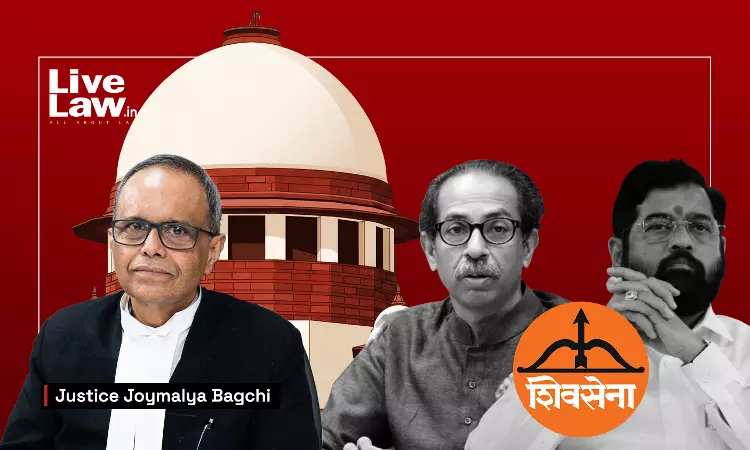
A bench of CJI Surya Kant, Justice Joymalya Bagchi and Justice V Mohana was hearing the challenge made by Uddhav Thackeray to the Election Commission's decision under Paragraph 15 of the Election Symbols Order recognising the Eknath Shinde faction as the real Shiv Sena and allowing it the use of the 'bow and arrow' symbol.
Justice Bagchi questioned the Election Commission's reliance on the legislative majority test to recognise the Eknath Shinde faction as the real Shiv Sena and asked why ECI did not even consider the option of refusing to recognise either faction as the political party.
“Now the authority has four options. It looked into only three options. We would have understood a line saying that, no, this is not a case where we can go for the fourth option because of the sentiments attached to this very profound symbol and a historical attachment, which none of the parties or the factions would have agreed. We would have accepted”, he said.


Justice Bagchi was referring to four possible courses available to the ECI in deciding the dispute – a) examining the party Constitution and its organisational structure, b) applying an organisational-majority test, c) applying a legislative-majority test, or d) as a residual option, declining to award the reserved symbol to either faction. He questioned why the ECI went with option c) without even considering option d).
Senior Advocate Neeraj Kishan Kaul for the Shinde faction has earlier contended that the legislative majority test was adopted because ECI found that the party Constitution and organisational majority were not feasible in this case.
Today, Kaul continued to defend the ECI's reliance on the legislative-majority test. He submitted that Paragraph 15 does not prescribe any particular test and that the Commission is entitled to fashion an appropriate test depending on the facts of a case.
Justice Bagchi, however, focused on the Constitution Bench judgment in Subhash Desai v. Principal Secretary, Governor of Maharashtra, which discussed the limitations of the legislative-majority test while also holding that no single test could be prescribed for disputes under Paragraph 15.
Justice Bagchi noted that earlier judgments such as Sadiq Ali and Anr. v. Election Commission of India and Ors. had considered legislative strength while deciding disputes between rival factions, but those judgments pre-dated the Tenth Schedule. He noted Subhash Desai judgment did not completely discarded the legislative test, but had examined its “fragility”.
Justice Bagchi noted that the Constitution Bench expressly said that it was not examining the merits of the ECI's Paragraph 15 decision, while nevertheless made extensive observations on how such disputes should be approached and the weight to be given to different considerations.
He noted that the Constitution Bench had described the legislative majority test using terms such as “weak”, “diluted”, “futile” and “debatable”, while also referring to other possible tests. He wondered how those observations were to be understood alongside the statement that no singular test could be fashioned.
Kaul submitted that those observations did not eliminate legislative majority as a permissible test. He said that the ECI had considered the relevant tests and had given reasons for ultimately relying on legislative strength.
Justice Bagchi responded that this could not necessarily be read as permitting the legislative test to operate as the sole test in circumstances where the Constitution Bench had itself found it to be weak or futile.
He then raised the question of what the ECI should do if the available tests do not provide a sufficiently strong basis for choosing between rival factions.
“If none of these tests appear to be strong, then what else? Why give a prize to one? Cancel it”, he said.
Justice Bagchi was referring to the residual option of not awarding the reserved symbol to either faction. He described this as an exceptional course, likening it to a “rarest of rare” situation because, in doing so, a death sentence is being pronounced.
The judge nevertheless questioned why the ECI had not even examined this option in its decision.
“It is, let us say, in a sentencing process, the rarest of rare situations, because we are pronouncing a death sentence on the party. So only where the ECI could not have any other option, it would have resorted. And ECI actually is ruling out the organization itself. Why is it not ruling out? It's like saying, 'I (ECI) have to go for the legislative majority.' Is it the only option? Because there was a residual exceptional option. That has not been addressed.”
He then framed the issue specifically in terms of judicial review. If four options were available to the authority but only three were considered, he asked, could the failure to consider the fourth option be a ground for judicial intervention?
He stressed that the Court was not seeking to decide which option the ECI should have adopted, but was examining the manner in which the Commission arrived at its decision.
“When we see judicial review, if four options are open and the authority does not address the fourth option, will we say the decision is liable to intervention in judicial review. We are not to decide, but we are to see the manner in which that is addressed”, he said.
Justice Bagchi observed that the Court would have understood the ECI's decision if it had expressly addressed the fourth option and explained why it could not be adopted because of the historical significance attached to the Shiv Sena's symbol. He referred to Sadiq Ali judgment, in which the historical significance attached to the Congress symbol had been considered.
However, there is nothing in the ECI judgment explaining why this option could not have been exercised, he pointed out. He highlighted that ECI did not address this option at all.
“Like Sadiq Ali where in Congress, it's a big tradition attached to this. We cannot junk it. So if we had found that paragraph, I wouldn't have put that question?” he asked.
Justice Bagchi clarified that the Court was not seeking to intervene in Kaul's submissions or asking the Court to substitute its own assessment for that of the ECI.
“Because you are making out a very good case that we cannot substitute on merit the decision of a body like ECI,” Bagchi said. “If it's a special body, an expert, we will have to defer to it.”
However, he reiterated that the Court could still examine whether a relevant consideration or outcome had been left unaddressed.
“But however, when we see judicial review, like consideration of all relevant facts, a fourth relevant outcome or a relevant outcome possibly not being addressed, will it not be a matter of consideration?” he asked.
Kaul submitted that he would address this question in the course of his arguments.
The hearing will continue tomorrow.
Previously - Shiv Sena Row | Why Didn't ECI Allot Neutral Symbol To Eknath Shinde Side? Supreme Court