

Acknowledge Dagar Brothers' Performance In 'Veera Raja Veera' Song : Supreme Court Urges AR Rahman
Anmol Kaur Bawa
13 Feb 2026 2:57 PM IST
Without getting into the legal issues, the Court orally suggested that there should be "some acknowledgement".
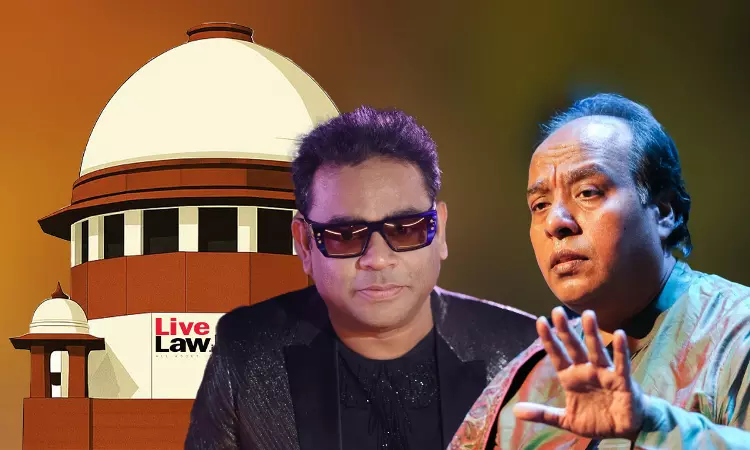
The Supreme Court on Friday urged music composer AR Rahman and the producers of Tamil film Ponniyin Selvan II to acknowledge that the music of the "Veera Raja Veera" song was drawn from the 'Sihva Stuti' originally performed by the Junior Dagar Brothers in the Dagarvani tradition.
A bench comprising Chief Justice of India Surya Kant and Justice Joymalya Bagchi was hearing a plea by Dhrupad singer Ustad Faiyaz Wasifuddin Dagar challenging the Delhi High Court order, which set aside the injunction order against music composer AR Rahman with respect to the composition 'Veera Raja Veera' in the Tamil film Ponniyin Selvan II.
Noting that Rahman acknowledged that the song was from the Dagarwani tradition, the bench asked if it could be further acknowledged that the song was first performed by the predecessors of the petitioner.
Addressing Rahman's lawyer, Senior Advocate Dr Abhishek Manu Singhvi, Justice Bagchi said :
"Instead of going into the legal niceties, they were the part of the Dagarwani tradition which you have already acknowledged. The originality of the tune is undisputed. There is a dispute as to authorship, but there is no dispute as to the performer right. In your slide, you have said this is from Dagarwani tradition, if you could introduce that performed for the first time by the parents of the Dagar..you understand? So at least this can be done"
CJI Kant asked, "If these gharanas had not contributed to the shastriya sangeet, do you think these modern singers would have managed?"
Justice Bagchi said that he had heard the subject song and the Gundecha performance of the Dagar's music yesterday.
Singhvi agreed to consider the bench's suggestion, "I hear your lordship's subtext. You are not on the law or the fight. We have been very fair from the beginning in carrying that line. My lords are now saying add that one line regarding performance. I will take instructions."
Singhvi added that the Dagar's music was performed by Gundecha in 1991, by Uday Bhawalkar in 2015, in 2017 by Nirmala De and in 2023 by Kabeeri Kar, and the petitioner never raised any objection. "Nevertheless, what my lords are saying, add a line, as a first performer, I can take instructions and come back."
"There should be some acknowledgement. This is not a fight between professionals. Your client is a professional musician. They have been traditional worshippers of classical music. They are not in the competitive field. They just want some respect and recognition," Justice Bagchi said.
"As a first performer- let me take instructions," Singhvi said. He added that this concession, if made, will be without prejudice to the contentions in the suit.
Dagar has alleged that the Tamil composition was an infringement of the 'Shiva Stuti' composed in the Dagar tradition. In April 2025, a single bench of the High Court passed an interim order directing Rahman and the makers of the film to give credits to the Dagar brothers for the song and to deposit Rs 2 crores as security. In September 2025, a division bench of the High Court set aside the interim injunction order.
Background
The case arose from the use of a classical Dhrupad composition “Shiva Stuti” in the Tamil film song “Veera Raja Veera” composed by A.R. Rahman for the film Ponniyin Selvan 2.
The controversy arose after the film's theatrical release on April 28, 2023. Ustad Faiyaz Wasifuddin Dagar alleged that protectable portions of “Shiva Stuti”, a composition attributed to the late junior Dagar Brothers had been included into the song without any authorisation.
According to Faiyaz, Shiva Stuti was jointly composed by the late Ustad Faiyazuddin Dagar and late Ustad Zahiruddin Dagar in the 1970s as part of the Dagarvani tradition of Hindustani classical music. The composition was first publicly fixed and recorded during a performance at the Royal Tropical Institute at Amsterdam on June 22, 1978 and later published through commercial recordings. Dagar claimed that copyright and moral rights in the composition devolved upon him after a family settlement following the demise of the original composers.
Dagar further alleged that two of his disciples who later participated in the recording of Veera Raja Veera had shared the composition with A.R. Rahman without consent. He argued that the song reproduced the core melodic structure, Swara patterns, rhythm cycle and emotional expression of Shiva Stuti, amounting to infringement of both copyright and moral rights. When no resolution was in sight, Ustad filed a commercial suit before the Delhi High Court in 2023, seeking injunctions, recognition of moral rights, damages and attribution. On April 25, 2025, a single judge bench of the court partly allowed interim relief, directing correction of credits, deposit of Rs. 2 crores as security and payment of costs.
Aggrieved by the order, A.R. Rahman filed an appeal before the division bench of the high court. The appeal questioned the findings on originality, authorship, and the grant of final relief at an interlocutory stage. The division bench set aside and modified portions of the single judge's interim order, including the direction requiring a Rs 2 crore deposit and certain observations that effectively amounted to final findings. At the same time, the court did not fully accept Rahman's case and clarified that all issues relating to authorship, originality and infringement would be decided at trial. Aggrieved by the vacation and dilution of interim relief, Dagar has now approached the Supreme Court
Case Details : USTAD FAIYAZ WASIFUDDIN DAGAR Versus A.R. RAHMAN AND ORS.| SLP(C) No. 4742/2026