



- Home
- /
- Top Stories
- /
- Supreme Court Orders SIT Probe Into...
Supreme Court Orders SIT Probe Into Illegal Gravel Mining In Rajasthan's Luni, Jojari And Bandi Rivers, Bars New Industries Near River Ecosystem
Amisha Shrivastava
6 Nov 2026 9:55 PM IST
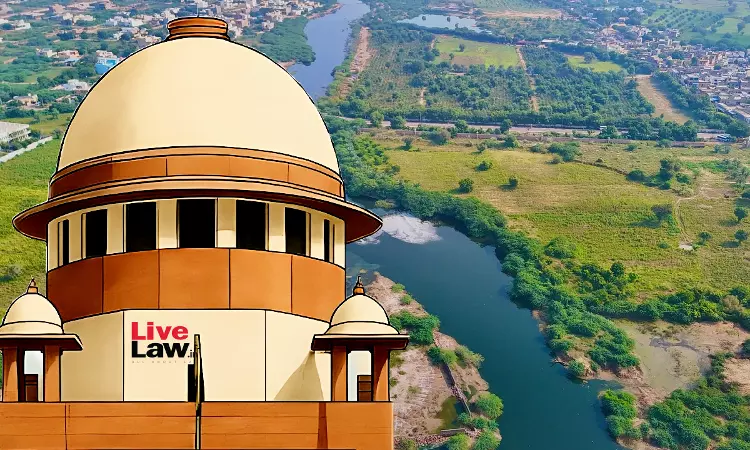
The Supreme Court has directed the Rajasthan government to constitute a Special Investigation Team (SIT) within three days to investigate organised illegal bajri (gravel) mining in the Luni, Jojari and Bandi rivers and their tributaries, including the involvement of public officials in facilitating such activities. A bench of Justice Vikram Nath and Justice Sandeep Mehta, in an...
This is a premium content
Available exclusively to
Our subscribers
Subscribe Premium 
INR 1099+GST
Your support helps us to bring you more content at
an affordable subscription scheme !!!
All payment options available
The Supreme Court has directed the Rajasthan government to constitute a Special Investigation Team (SIT) within three days to investigate organised illegal bajri (gravel) mining in the Luni, Jojari and Bandi rivers and their tributaries, including the involvement of public officials in facilitating such activities.
A bench of Justice Vikram Nath and Justice Sandeep Mehta, in an order dated October 26, also restrained the State from granting permissions for the establishment of new industrial units along or in the vicinity of the riverine ecosystem until the High Flood Line and buffer zones are scientifically determined.
The SIT, to be headed by an officer not below the rank of Inspector General of Police, will include the Superintendents of Police of Jodhpur, Balotra and Pali.
“The SIT shall undertake a comprehensive investigation into organised illegal bajri mining activities affecting the Luni, Jojari and Bandi rivers and their tributaries. The investigation shall extend to identifying the persons and entities involved in such activities, the networks through which the illegal extraction, transportation and sale of bajri are organised, and the beneficiaries of such operations”, the Court ordered.
The SIT also has to examine whether public officials facilitated or enabled illegal mining, including instances of collusion, dereliction of duty or failure to act despite knowledge of violations. Appropriate action has to be initiated against those found responsible.
The Court directed the SIT to file a status report before it on or before the next date of hearing on 27th November, 2026.
The Court directed that an additional protective zone of 100 metres be maintained on either side of the respective recorded outer boundaries of the rivers. The Court held that No Red Category industry shall be permitted to be established within a distance of 500 metres from the said recorded outer boundaries.
Observing that the issues involved in the present proceedings are complex and multifaceted in nature, the Court appointed Senior Advocate Balbir Singh along with Advocate on Record Namit Saxena as Amici Curiae to assist the Court in the effective consideration and resolution of the issues.
The Court passed the directions in the suo motu proceedings concerning pollution in the Jojari-Luni-Bandi river system, which has affected the environment and the lives of approximately 20 lakh people.
On the previous date, the Court had warned Rajasthan authorities of a Central Bureau of Investigation (CBI) probe into alleged illegal mining and the regularisation of mining areas along the Jojari-Luni-Bandi river system, questioning why State authorities granted mining leases in areas where illegal mining had been detected, and regularising illegal leases.
Court deprecates attempt to legitimise illegal mining through subsequent lease grants
The Court expressed serious concern over the Rajasthan Mining Department's explanation that mining leases had been subsequently granted according to prescribed procedures in several areas where illegal gravel mining had previously been detected.
“The fact that mining leases may have subsequently been granted in accordance with the prescribed procedure does not, by itself, answer the question whether the grant of such leases is environmentally sustainable or consistent with the need to preserve and restore the natural course, riverbed and ecological integrity of the river systems,” the Court observed.
It observed that the authorities attempted to legitimise illegal mining activities through subsequent lease grants instead of taking appropriate action against those responsible. It added that it would consider directing appropriate action against officers found responsible for permitting or facilitating such activities.
“We deprecate the apparent attempt on the part of the Mining Department of the State of Rajasthan to legitimise illegal mining activities being carried out in the riverbeds by subsequently granting mining leases, rather than taking appropriate action against those responsible. We shall consider directing appropriate action against the officers found responsible for permitting or facilitating such activities.”
It added that accepting the State's explanation without scrutiny would risk reducing illegal mining to “post facto regularisation and sanctioning of activities that were otherwise illegal”.
The Court emphasised that compliance with the procedure for granting a mining lease and compliance with environmental safeguards governing actual mining operations were distinct requirements.
It said that the environmental impact of areas subsequently brought under mining leases must be independently assessed, considering natural river flow, integrity of riverbeds and banks, replenishment capacity, groundwater recharge and cumulative mining across contiguous stretches.
“The State cannot discharge its obligation to protect the river systems merely by reporting the number of cases detected, FIRs registered, penalties recovered or leases granted. The relevant consideration is whether the measures adopted are capable of preventing further degradation and securing the restoration of the affected areas,” the Court said.
Mechanism for anonymous complaints against illegal mining
The Court directed that the Integrated Public Reporting and Environmental Grievance Redressal Mechanism, earlier ordered to be established on August 7, 2026, incorporate a facility for submitting anonymised complaints concerning illegal bajri mining and other unlawful activities affecting the river ecosystem.
The mechanism must provide for recording, examining and referring complaints to competent authorities for appropriate action.
State to respond to concerns about groundwater depletion in Jodhpur, Balotra and Pali
The Court directed Rajasthan to file a separate affidavit addressing concerns raised by one Digvijay Singh Jasol regarding groundwater depletion, industrial pollution and the ecological condition of the Balotra region.
Jasol submitted that the Balotra block, comprising Balotra, Bithuja and Jasol, has been classified as a Dark Zone/Over-Exploited Area since the 1990s due to groundwater extraction exceeding recharge.
Referring to findings of the National Green Tribunal, he submitted that groundwater extraction for commercial and industrial purposes has been prohibited in such areas and permitting extraction for industrial activities would further threaten water security.
He also referred to a National Productivity Council report highlighting extensive groundwater contamination in Balotra and Pali and the need for further hydrological studies.
The Court directed the Central Ground Water Authority (CGWA) to be impleaded in the proceedings within one week. The authority has to file an affidavit setting out the status of groundwater availability, extraction and depletion in Jodhpur, Balotra and Pali districts, along with its assessment of the prevailing groundwater situation.
NGT can examine independent regulatory orders passed by the Rajasthan State Pollution Control Board
Separately, the Supreme Court clarified that its earlier directions dated 18th March 2026 and 29th May 2026 restricting the resumption of operations by closed industrial units did not extinguish the National Green Tribunal's statutory appellate jurisdiction to examine independent regulatory orders passed by the Rajasthan State Pollution Control Board.
The Court was considering applications filed by Bherawa Textile Industries Pvt. Ltd., whose Consent to Operate, valid until January 31, 2030, was revoked by the RSPCB on August 18, 2026, and whose unit was directed to be closed.
The company filed an appeal before the NGT challenging the closure order. However, after the RSPCB relied upon the Supreme Court's earlier orders, the NGT directed that the proceedings would be governed by the Supreme Court's directions. The company subsequently withdrew its appeal without adjudication on merits.
The company sought clarification that the Supreme Court's orders did not prevent the NGT from examining the legality of the closure order.
By the orders dated 18th March, 2026 and 29th May, 2026, the Court had cast an obligation upon the concerned authorities of the State of Rajasthan and the RSPCB to take appropriate enforcement action against industrial units operating in violation of statutory requirements, the conditions stipulated in their Consent to Operate, or the prescribed environmental standards.
The Court had further directed that industries ordered to remain closed pursuant to the action taken by the State of Rajasthan and the RSPCB shall not be permitted to resume operations except with the prior leave and express permission of the Court.
In the latest order, the Court clarified that the directions were intended to ensure strict compliance with the applicable environmental norms and to prevent the continued operation of units found to be in breach. However, they do not extinguish the statutory appellate jurisdiction of the NGT to examine the legality and sustainability of an independent regulatory order passed by the RSPCB, the Court said, highlighting that adjudication of a challenge to the legality of an independent regulatory order was distinct from permission to resume operations.
"These directions were intended to ensure that no industrial unit resumes operations without satisfying the requisite environmental standards and obtaining the express permission of this Court. They must, however, be understood in the context of their object and scope, namely, the enforcement of environmental safeguards and the regulation of the resumption of operations by industrial units. The aforesaid directions cannot be construed as excluding or extinguishing the statutory appellate jurisdiction vested in the NGT under the NGT Act, 2010 to examine the legality and sustainability of an independent regulatory order passed by the RSPCB. The adjudication of a challenge to the legality of such an order is distinct from the grant of permission to resume operations. The exercise of appellate jurisdiction by the NGT, in accordance with law, would not, by itself, dilute or circumvent the binding directions issued by this Court, nor would it entitle an industrial unit to resume operations contrary to those directions", the Court held.
The Court disposed of the company's applications with liberty to approach the NGT seeking restoration of its withdrawn appeal.
Tags

Amisha Shrivastava
Amisha Shrivastava is a Senior Correspondent with LiveLaw, covering the Supreme Court of India. She can be reached at amisha@livelaw.in

