



Supreme court
Know The Law | Consequences Of Not Furnishing Written Grounds Of Arrest : Supreme Court Explains
The Supreme Court recently reiterated that an accused has a fundamental and statutory right to be informed of the grounds of arrest in writing, and the written grounds must be furnished to the arrested person as a matter of course and without exception.A bench of Justice Ujjal Bhuyan and Justice Atul Chandurkar stressed that the requirement under Article 22(1) of the Constitution is not a...
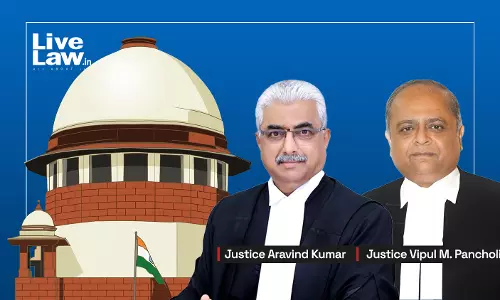
Article 311 Bar Not Attracted If Officer Removing Employee Is Equal In Status To Appointing Authority : Supreme Court
The Supreme Court today (24 September) has held that the constitutional protection under Article 311(1) of the Constitution is attracted only when the removing authority is subordinate in rank to the authority that made the appointment. It was also held that mere delegation of disciplinary powers to a subordinate officer under statutory rules does not trigger the constitutional bar. For...
SARFAESI Proceedings Can Be Invoked Despite Earlier Decree Passed In DRT OA For Same Debt : Supreme Court
The Supreme Court has recently dismissed a writ petition filed under Article 32 of the Indian Constitution challenging the invocation of the Securitisation and Reconstruction of Financial Assets and Enforcement of Security Interest Act, 2002 (SARFAESI Act) by an Asset Reconstruction Company (respondent), holding that the overriding effect of Section 35 of the SARFAESI Act permits such...
Supreme Court Upholds Asst Professor's Appointment Despite Doubts Over PhD, Orders University Probe
The Court refused to interfere with the appointment on the ground that PhD was not a mandatory qualification for the post.
Art. 226 | Certiorari Can Be Used To Quash Tribunal Decision Which Is Grossly Perverse : Supreme Court
The Supreme Court on Monday (August 31) held that High Courts, while exercising their certiorari writ jurisdiction under Article 226 of the Constitution, can interfere with a Tribunal's order where the findings are unsupported by any material or documentary evidence. “If a finding is recorded without there being any evidence on record or a finding is recorded without any supporting...
Speedy Trial Also A Right Of Victim; Accused Cannot Use Pending Gangsters Act Case To Stall Other Trials : Supreme Court
Observing that a right to a speedy trial is not only the prerogative of the accused, but is also a valuable right of the victim, the Supreme Court on Monday (August 17) set aside the Allahabad High Court's order which had kept a murder trial against an accused in abeyance merely because a proceeding under the UP Gangsters Act was pending against him. Allowing the complainant's appeal, a...
Judgments Are Retrospective Unless Expressly Made Prospective : Supreme Court
The Supreme Court has reiterated that unless its judgment expressly states that the decision would apply prospectively, it shall apply retrospectively. “If a decision of the Apex Court does not expressly provide its application to be prospective, then it is settled law that all decisions of this Court are retrospective in application…”, observed a bench of Justice Dipankar Datta...
Supreme Court Upholds Constitutionality Of Sentences Of Imprisonment For Remainder Of Natural Life Without Remission
The Supreme Court has upheld the constitutional validity of sentences directing imprisonment for the remainder of a convict's natural life, dismissing a batch of writ petitions that challenged such punishments as unconstitutional and contrary to the statutory remission framework.A Bench of Justice Sanjay Karol and Justice Augustine George Masih rejected petitions filed by four sets of...

Supreme Court Grants Bail To Two UAPA Accused In Jail For 12 Years, Says Slow Trial Violated Article 21
The petitioners were booked over the alleged recovery of explosives linked to Indian Mujahideen module.
National Scheduled Castes Commission Has No Adjudicatory Role; Only Advisory : Supreme Court Quashes Order In Service Dispute
The NCSC has only been given a limited role, which is recommendatory and not adjudicatory, the Court stated.
Art. 311(2) | Confirmed Public Servant Can't Be Terminated Over Alleged Illegal Appointment Without Inquiry: Supreme Court
The Supreme Court has ruled that a public servant whose service is confirmed cannot be terminated from the office merely because there was an alleged illegality in appointment. The Court said that a termination without holding a departmental inquiry would be violative of Article 311(2) of the Constitution. “Confirmation in service is not a mere administrative formality but it confers upon...